Monday, March 11, 2013

Decoding the Jargon


Welcome to another installment of the sports terminology translation station.

Since Rosetta Stone hasn’t yet developed a ‘sports watchers to non sports watchers’ educational explanation software yet, the time has come to translate common sports terminology for those who don’t speak fluent ESPNeese.  

Sadly there aren’t enough inches in this column to break down every single sports term and its immediate meaning. Instead the focus here will be to breakdown the backhanded complements of sports that share the airwaves with Michael and Kelly.

The first term that deserves decoding is the term ‘glue guy.’ Usually this term comes up primarily in basketball, although baseball and hockey see this term in their word banks occasionally. The player’s relevance to the team is usually brought up when Skip Bayless or Stephen A. Smith are in the middle of debating who the better team is.

What a ‘glue guy will’ most commonly be defined as is a mediocre player whose primary function is to be a catalyst to improve team chemistry. In the NBA guys like Derrick Fisher of the Oklahoma City Thunder would be a good example.

Back in Fisher’s heyday with the Los Angles Lakers from 2000-2004 he averaged roughly eleven points per game and his signature moment was a falling away ‘there-is-no-possible-way-this-shot-should-go-in-but-why-the-hell-not’ three pointer in the 2004 playoffs.

Nowadays Fisher is a backup guard who will occasionally hit a three point shot; that is if he has enough space to read “War and Peace” before a defender gets to him.

Talking heads and journalists will reward the ‘glue guy’ term to a good teammate who can’t produce on the court anymore in order to get good quotes from him after the game. Everyone who follows Fisher knows that he hasn’t averaged more than ten points per game since 2008 and hasn’t been a reliable defender since 2005.

Yet because Fisher is a nice guy who serves as an important catalyst for team chemistry, nobody is going to outright say Fisher sucks. Instead they give him the backhanded complement of being a ‘glue guy.’

Synonyms for glue guy include ‘hustle player’, ‘hard worker’, or any player description that includes the word grit. 

Now the sports terminology translation station will break down what it means to ‘turn back the hands of time.’ This phrase will make appearances from football to hockey and every sport in between.

When a player ‘turns back the hands of time’ he or she is an older player who is statistically producing similarly to when they were in their prime. Anyone who has watched ESPN in the last two weeks has heard this term applied to Kobe Bryant after two historically great (40 plus points and 12 plus assists) games in a row.

Although the black mamba deserves the praise, there is a bit of bile in pundits saying Kobe turning back the hands of time.

For one thing that phrase is a not so subtle reminder that Bryant has played in the NBA for 17 seasons and is 34 years of age. Kobe being an experienced NBA player is not necessarily a bad thing because certain players do get better with age; like a fine vino.

Still nobody likes to be reminded that they are not as young as they once were and Bryant probably doesn’t want to be reminded that the last championship he won was in 2009-2010. He is still a good player who happens to be up there in years.

While there are no synonyms for the phrase ‘turning back the hands of time’ although there is probably one daylight savings time joke in there somewhere.

Another term to break down depicts the constant breaking down of athletes’ bodies.

When a player frequently gets hurt over the course of their career they are plagued with the dreadful ‘injury prone label.’ This term is also not sport specific and has more people fit the bill than in a casting call for Les Miserable.

Perhaps one of the most drastic cases of an ‘injury prone’ player would be former Boston Red Sox outfielder and vanilla ice cream substitute J.D. Drew.

Over the course of his career, the infamous Drew missed roughly 96 games per year during a five year span in Boston. The injuries ranged from a strained lower back to sore knees to ouchies that saw Drew out of the Red Sox lineup a total of 606 regular season games with the Red Sox.

Drew missed so much time due to injury that the fan base of Red Sox nation not only questioned the severity of Drew’s injuries, but also assigned him the dubious (but hilarious) nickname of “Nancy Drew.”

Synonyms for injury prone include ‘just can’t seem to stay healthy,’ ‘injury plagued,’ ‘soft,’ ‘frail’ or in the most extreme circumstances ‘quitter.’

While ‘injury prone’ is by far the most condescending term that the translation station has defined perhaps the most loaded term would be ‘trade bait.’

Players who are ‘trade bait’ are athletes that a franchise is looking to get rid of in return for other players, draft picks, cash, or some combination of the three.

On the surface that doesn’t sound so bad because ‘trade bait’ implies that the player openly being shopped has value. However, the notion that a player is expendable decreases his overall value to the team and therefore some could have a lower opinion of his or her production.

Before the NBA trade deadline this year Los Angeles Clipper guard Eric Bledsoe was mentioned in more rumors than Kris Humphries and his wife.

Bledsoe put up good numbers for his team off the bench for the Clips (21 minutes, nine points, three rebounds, and three assists per game) was a player with the potential to get better (age 23) and was a part of the deepest team in the NBA.

So the Clippers tried to dangle Bledsoe as trade bait in order to lure that final piece to make a championship run this season. Bledsoe ultimately didn’t get traded and now his value has depreciated because of the Clips openly willing to bargain for Bledsoe.

The biggest reason that being acknowledged as trade bait is partially condescending is because it can hurt the psyche of a player. If a player has to hear that his or her name is being discussed in trade rumors then it automatically becomes a distraction to the team.

Instead of worrying about winning, trade bait players like Bledsoe have to answer questions about how they are dealing with the rumors of their impending departure. 

The free trial in ESPNeese is now over. Hopefully now the language of sports is a bit easier to translate. 

Monday, March 4, 2013

Out of Bounds


Dennis Rodman has more or less the same credibility when it comes to foreign diplomacy as an inmate in Sing Sing.

This is a man who put on a wedding dress just to promote his book back in 1996. Rodman had an MTV show in which he interviewed guests from the comfort of his bed. Rodman has been to rehab, driving whilst intoxicated, and multiple domestic violence incidents.

Yet all of that outward lunacy pales in comparison to Rodman’s recent visit to North Korea for the purposes of ‘basketball diplomacy.’ Over the weekend the madman of the midway met with the madman of east Asia, Kim Jong Un, and said “As a person to person, he (Un) is my friend.”

To be fair one has to put Rodman’s words in proper context. Many will misinterpret Rodman’s one on one meeting with Un as Rodman accepting Un’s rule of his people. In reality, Rodman’s one on one interaction was just a fan admiring a great basketball player.

Even though that fan is a ruler of a country and Un treated the hall of famer better than any of the citizens he is in charge of.

It does not take John Kerry to tell you that as a ruler of a country Un has been far from exemplary. An article by BBCnews.com said that 3.5 million people have starved to death in North Korea since 1995. And the U.S. is still technically fighting the Korean war because a peace treaty was never signed after the 1953 truce ‘ended’ the Korean War.

It is hard to figure out which is scarier, the fact that Rodman wants Obama and Un to talk about basketball or that Rodman probably got closer to Un than anyone in U.S. intelligence in the last half century or so.

Seriously in a CNN.com article reported that former Assistant Secretary of State Stephen Ganyard told ABC News, "There is nobody at the CIA who could tell you more personally about Kim Jong Un than Dennis Rodman, and that in itself is scary.”

It’s terrifying actually. Nobody can take this meeting seriously because of the man who supposedly bonded with Un. Rodman gets his sanity questioned on a daily basis, and he is supposed to be the man who leads the U.S. to peace negotiations with an enemy government?

That is simply not going to happen. Not every international sports story will be Invictus. If Un wanted to bring the citizens of North Korea together and better his nation through some form of basketball diplomacy he’d have to actually feed his people first.

While the principal of being the bigger nation and talking to your enemy may be noble there are people in this world in which reason fails to reach them; and Un is one of those people incapable of reasoning.

And Rodman very well may be a person incapable of fully grasping reason himself.

Although sports reporters from Chicago to San Antonio swear that Rodman has a good heart most of them will not refute Rodman’s questionable sanity. If there is an athlete in the world who is to unify people for a cause it is most certainly not a man who is regarded as one of the dirtiest players in NBA history.

Though Rodman has been making a fool out of himself for his entire professional life it was inconceivable to think belittling diplomacy was in his arsenal. Dennis Rodman having an affair with Madonna, sure that’s possible. A professional athlete making an a-hole out of himself happens every day.

But to pretend that there was any kind of good that came out of two insane man vying for the President of the United States to talk with them about basketball is just plain dangerous.

Now that Rodman has had his moment back in the spotlight the men in the white coats can put him back in his straight jacket. 

Monday, February 25, 2013

Unwind, It's Just the Combine


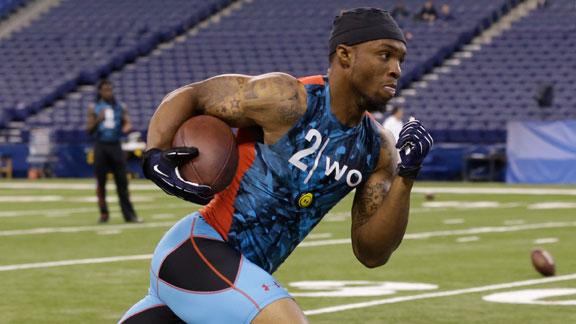
This past week Manti Te’o went to the NFL combine and was lambasted by the media regarding questions about the girlfriend that was as real as the lockness monster.

The kid answered the questions well and called the hoax ‘embarrassing,’ yet other than that he went about his business trying to prove himself for the scouts and general managers of the league.

Even after all of the memes, jokes, columns taking shots at his character, and ‘Manti Te’o Girlfriend Kiss-cam’ gags, Te’o’s talent outshines this particular scandal.

So Te’o, and the other 31 guys expected to be drafted in the first round in April really don’t need the services the NFL combine provides.
                                                          
It would not be any form of national travesty if the cream of the draft stock crop just up and decided not to work out at the combine. For the guys who are already going to get millions of dollars on their first contract, the combine is about as meaningful as going on a college interview when you’ve already received the acceptance letter.

Granted general managers and scouts watching guys jump, sprint, catch, lift weights, and condition does serve a purpose. The combine serves as a plateau for the unknown guys who didn’t play in a BCS Bowl game. A guy from Wichita State who may get drafted in round seven needs the attention of NFL teams more than the number one wide receiver prospect in the class.

So give the guy who needs a chance his fare shake by telling the guys who are going in the top 32 to stay home.

It’s not as if general managers and scouts are only giving a crap about the best once they walk into Indianapolis for the workouts. It is their job to watch countless hours of game film and hone in on a top player’s strengths and weaknesses. If the GM determines that this talent is worth x number of millions it makes more sense to spend the resources on some unknowns in order to have a deeper draft.

Perhaps the most popular example of the need for a deep draft (that you will hear way too much about come draft day) is that quarterback from Michigan that was drafted in round six in the year 2000 by the New England Patriots: you know that Brady guy.

The Pats first pick in that draft was some guy named Adrian Klemm out of Hawaii and he was out of the league by the year 2005.

In sports when a college kid from a big name school is good the entire professional community already knows about it. But when the schools are smaller kids have the potential to fall through the cracks.

In reality the guys who are projected to be first round draft picks can afford to take the combine off and not face any major consequences. And general managers would be better off focusing their resources on the unknown guys in order to get more good players in the same draft class.

This idea may not be as crazy as the Te’o girlfriend story, though it certainly is crazy enough to work.


Monday, February 18, 2013

All Star Burnout?


In between fantastic dunks, Chris Paul making Chris Bosh’s legs look like old western saloon doors, and Blake Griffin making fans beg for him to be in the dunk contest again there was something missing from the game; you know other than defense.

 That’s it; the All Star game was missing that unique relevance that makes the game matter.

It is not just in the NBA where the score has the same amount of worth as the points from Whose Line is it Anyway? None of the All Star Games have any relevance to the season.

Sure baseball tried that whole ‘winner of the all star game gets home field advantage in the world series’ thing back in 2003 to make the game matter. By doing so, teams in baseball who win more games does not mean that they get the deserved benefit of having home field advantage in the most crucial series of the year.

Instead, some terrible pitch from the Kansas City Royals pitcher could ruin the Yankees shot at having home field in the World Series.

The NFL is completely considering getting rid of the Pro-Bowl all together because they know the players don’t try to play hard and most of them don’t care about going.

Yet even though the games don’t matter, the spectacle draws well.

According to an article by broadcastingcable.com, a total of eight million people turned on TNT to watch the biggest names in basketball play the most anticipated pickup game of the year.

The pickup game mentality of the All Star game makes all of the statistics funnier than anything Dane Cook has ever said. Entering the game Kevin Durant had the chance to win consecutive all star MVP awards. This feat had not been accomplished in thirty years.

You can file that stat away with shooting percentage in hockey, wins above replacement in baseball, and total quarterback rating in football under the category of ‘nobody gives a flying fudge’ statistics.

Seriously, USA Today.com wrote an article back in 2011 suggesting that Kobe Bryant could be the greatest all star gamer ever. Bryant owns the all star game record for starts and four all star game MVP awards. Naturally the debate raged on about his performance in all star games compared to the best of the pickup games.

Being the greatest all star game player in league history is like Rihanna a teen choice award for her acting in Battleship: compared to the rest of their career accomplishments this one wins the Oscar for most useless.

This is not saying that every all star weekend is completely without merit. The skills competitions in the NBA and NHL are quite entertaining to watch and the NBA slam dunk contest can provide all of the dramatic moments fans want to see.

Bettman, Goodell, Selig, Stern do your leagues a favor and scrap this all star crap. It is a flawed concept that no longer has a purpose to serve. There is good reason to believe that multi billion pro sports industries would survive purging the expenditures of one weekend flop-fest a year.


Sunday, February 3, 2013

Daring to Answer the PED Question


A wise man seeks knowledge and can spend an entire life's worth of searching for answers, only to find a sea of questions still roaring before him. 

This is not the case with performance enhancing drugs. 

For everyone who read Bill Simmons' latest piece (which was a well done article in every facet of writing by the way, and it has already incited debate across the internet) there are plenty of answers to the PED question. While Simmons addresses plenty of examples of wrongdoing in sports, he only damns wrongdoing and chastises the media and fans for not asking 'why don't we care that these guys cheat, and why don't we hold them to a higher standard?'

A fully loaded question has a chamber full of answers. Performance enhancing profiling, a seemingly arbitrary selection process of who cheated and who didn't based off of whether or not fans and the media like athletes, is a problem and one answer to the question.

Lance Armstrong is a world class jerk who was raked across the coals by everybody with a blog, podcast, column, radio show, or television talk show because his miraculous comeback from cancer was tainted. While Armstrong most assuredly deserved all of the scrutiny he deserved, there are the following points to consider.

  • Fans expect everyone in the Tour De France to bike across an average of 2,235 miles.
  • The shortest day of riding a bike during the tour is roughly 94 miles. 
  • The riders’ bike for 21 straight days, or three consecutive weeks depending on how you look at it.
  • The Pyrenees Mountain Chain is 305 miles long and has been a staple in the Tour De France since its inception. And that's the "easy" mountain in the race. 
  • The longest stage is about 140 miles.
  • Riding up a mountain is far more difficult due to the change in elevation and the decrease in breathable air. 
  • The cyclists ride their bikes through multiple countries at some point or another in the race. 
This race is ludicrous by the standards of a normal human being. Most people may not be able to do this race over the course of two months, let alone three weeks. There is no way that the Tour De France would be able to get enough athletes to compete in this race without the unwanted aid of performance enhancing drugs. 

But God forbid if anyone took performance enhancing drugs to even complete this daunting race. It is also unthinkable that football players who weigh as much as hogs and run as fast as gazelles can't do either of those things naturally. And anyone who can hit a baseball traveling 90 plus miles per hour over 430 feet more than 30 times a year in seven months has to be juicing.  

Yet everyone wants to know why we don't talk about it more. How come Stephen A. Smith and Skip Bayless haven't ripped each others' heads off over this issue on First Take yet? How come nobody has the stones to stand up and say 'I think these guys are all using PED's?' 
The easiest and perhaps most logical answer is that there is no course of action regarding PED's that will end well. 

You can't legalize performance enhancing drugs in professional sports because it could lead to a legalized drug race. 

Teams with the highest payrolls across MLB, the NBA, the NFL, and the NHL would start to pay doctors who prescribe drugs for boatloads of HGH, danazol, and toradol. If a team didn't have as many doctors to prescribe these drugs in their back pockets, they would in theory lose out to teams that accepted doping. 

The governing bodies of professional sports would look like hypocrites and be chastised publicly again and again ad nauseum. Picture Bud Selig legalizing the bane of his tenure as baseball's commissioner. He'd be strung up by his baseballs and lit into for failing to protect the integrity of the game until the day he died. 

Not to mention the players of every sport who used PED's would try to sue their respective league after they retired. The narrative for the athletes here is simple: I didn't know about the dangers of this particular drug I took for the better part of a decade, so I am going to sue you for money because I should be compensated for my ignorance. 

Ergo, PED post retirement compensation will mirror the concussion mess the NFL is dealing with right now. But because these drugs were legal, the lawsuits would be in the hundreds of thousands as opposed to the thousands.

Okay so legalizing performance enhancing drugs doesn't work, yet trying to irradiate them from professional sports is neither practical nor possible. 

The same way that kids will always try to find a way to get some form of high illegally professional athletes will try to utilize some method to gain a competitive advantage. Kobe Bryant can go to Germany to get his blood spun in some machine which nobody knows how it works  to completely rejuvenate his destroyed body, but Roger Clemens can't get injected with testosterone, or HGH, or whatever he used. Both are performance enhancing methods, yet Kobe's was not deemed illegal because...

The method of determining which methods of performance enhancing drugs are legal and which ones aren't has not been properly explained to everyone. To the casual viewer what a guy can do to enhance his performance and what they can't do remain unclear and vague. 

Still even if these methods are determined rationally and everyone knows which drugs they can and cannot use to enhance performance, athletes are always going to find illegal methods to try and gain a competitive edge. Biological passports or not, somebody is going to find a way to beat the system. 

Ultimately that form of testing will be perceived as ineffective because it didn't catch everybody. Therefore we are left with three options either legalize the PED's and initiate a legal drug race. Spend millions of dollars and make earth shattering rules that make PED's illegal; only to wait until somebody beats the best form of testing for the upteempth time and a cheater who we find to be 'great' breaks the hearts of millions again. Or maintain the status quo of PED profiling.

All of those options suck. Since there is no good answer to the PED question at this time, the easiest move is for sports fans to close their eyes, take deep breaths, and transport themselves to a place where athletes can do superhuman things on command.


Monday, January 28, 2013

When Someone Moves On


The return of Ray Allen to the TD Bank Garden had the Celtics faithful felling a bit like old lovers.

Allen became the king of the land beyond the arc wearing Boston green. He helped the Celtics re-establish themselves as a perennial contender in the Eastern Conference. Most importantly, he helped bring the Celtics fans banner number 17 in 2008.

Before this season began Allen parted ways with the Celtics after bitter in-fighting to join their “rivals” the Miami Heat. The moved was loathed by the fans from Kenmore to South-E and everyone else who occupies Legends Way for Celtics games.

Still the fans were able to applaud Allen before the game as a thank you for bringing the Celtics back to NBA relevance. Once he came into the game the love was lost and the boo birds sang their song of dejection.

The return of Allen to the Garden (pronounced Ga-aaahhh-den) happens to be the most recent case study of when a former player leaves your team and returns for the first time bearing the colors of someone else.

Usually how fans react to the return of a former player depends on a few factors. First and foremost is the circumstance in which a player departs the team. Fans are generally less mad at a player who enjoys the town they are in, but gets traded or released by management for one reason or another.

Players like Chauncey Billups formerly of the New York Knicks fit into this category. Billups was waived by the team two years ago in order to make room to acquire Tyson Chandler. Billups paid his dues, played well, and was respectful to the fans of Madison Square Garden.

So whenever Billups comes back as a member of the Los Angeles Clippers, he will receive a small token of appreciation from the fans before the game.

The next factor is where the player who left goes. Former Red Sox who become Yankees, a la Johnny Damon, was called “Johnny Demon” throughout his tenure in pinstripes because he was a favorite in Boston who left for the arch enemy.

But when Damon moved on to Tampa Bay and eventually Detroit, the Red Sox faithful softened their hatred and remembered how Damon helped the Red Sox win their first World Series in 86 years.

In the case of Ray Allen he was a exemplary player for his five years in Boston. He was the epitome of class and even maintained his composure throughout a torrent of trade rumors a year ago.

So while the Garden faithful don’t care for the fact that Allen took his talents to South Beach, the only ones who truly resent him are the guys who live in their mothers’ basements who call sports talk radio to complain about it.

Moving on is just part of the reality of sports. Even when sometimes moving on may be the hardest thing to do. 


Friday, January 18, 2013

Oh No Te'o


On October 2 Manti Te’o sat in front of a TV camera and proceeded to convince the world that he was distraught by the death of a girl who didn’t exist.

Even if Te’o was duped at the beginning of this tragic hoax, the sit down he did with ESPN’s Gene Wojciechowski immediately stripped him of deniability. That interview was the point of no return for Te’o as the victim, if he was ever the victim.

While Te’o spoke to Wojciechowski he controlled the story. His lies were being interpreted as facts. The made for Hollywood story was so good that everyone believed it for the duration of the college football season.

Te’o called the apparition “the most beautiful girl I’ve ever met, not because of her physical beauty but the beauty of her character.”

It is inconceivable that Te’o didn’t utilize this for his own gain. Te’o overcoming adversity and playing well in Kekua’s memory propelled his Heisman trophy campaign. Everyone could get behind an athlete who lost someone meaningful in their life.

Te’o and Notre Dame were compelling storylines for the entire year in part because of the false personal tragedy.

If Te’o truly was duped he would not have told the LA Times on December 10 that he was going to play a few days after her burial because “She made me promise, when it happened, that I would stay and play.”

That promise was false. The pictures of Kekua were instead of a woman named Diane O'Meara. The persona of Kekua was just a figure of Ronaiah Tuiasosopo’s warped imagination.

Granted these kids are not the only ones at fault here. Wojciechowski even admitted in an ESPN phone interview on January 16 that he couldn’t find Kekua in any obituary and did not speak to Kekua’s “parents” at Te’o’s request.

Still when a subject’s grief appears to be that real in the moment most journalists wouldn’t press in that situation. Especially if it was a college athlete at a prominent program who lost his grandmother earlier that month.

Between the lies of steroid users and Lance Armstrong, Te’o’s narrative was the alternative: an athlete who overcomes personal tragedy through good play.

Now that all important feel good storyline will be forever under fire for college football players. There will be conspiracy theorists who doubt the good stories of others because of Te’o’s selfish lies.

This story won’t impact Te’o’s draft stock because it doesn’t show up on game film. While Te’o did say her memory inspired him, scouts will just see how quickly he can get to a running back on tape.

If Te’o really was grieving, it is plausible to thing that at some point he would have stopped talking about her. A grieving boyfriend would eventually ask the media to leave him alone if they were pressing him, especially a college kid.

That is why it is impossible to believe Te’o was the victim. For how long the hoax lasted, how much he talked about her after learning she didn’t exist, how little the media knew about her, and how successful he was all suggest that Te’o knew of the ruse and used it to gain notoriety.

Te’o was a linebacker at a well known college who was a good player. This ruse was not necessary for him to reach the level of stardom he achieved. Now nobody can believe a word that comes out of his mouth ever again.

If Te'o ever plans to sit down for an exclusive interview again he better plan on getting his story straight.